Public port information is fragmented
Limits, tariffs, services, notices and contacts may be spread across websites and PDFs that are hard for people and software to reconcile.
MARINA AND HARBOUR INTELLIGENCE
MaritimIQ turns a harbour's public and operator-supplied information into a canonical, machine-readable dossier. Operators can make vessel limits, infrastructure, services, rules and tariffs easier to understand while keeping availability and contractual confirmation inside the systems that control them.
Present one stable harbour identity across search, partner systems and future updates.
Help yachts self-screen basic fit before staff spend time on an enquiry.
Distribute approved facts through a licensing-aware API while retaining source and validity.
WHY THIS ROLE NEEDS IT
Describe, compare and plan the physical and service environment that yachts depend on.
Limits, tariffs, services, notices and contacts may be spread across websites and PDFs that are hard for people and software to reconcile.
Inferred berth counts, stale dimensions and nearby services can produce requests the harbour cannot responsibly answer.
Traffic and declared capacity are not a substitute for the berth-management or reservation system's current state.
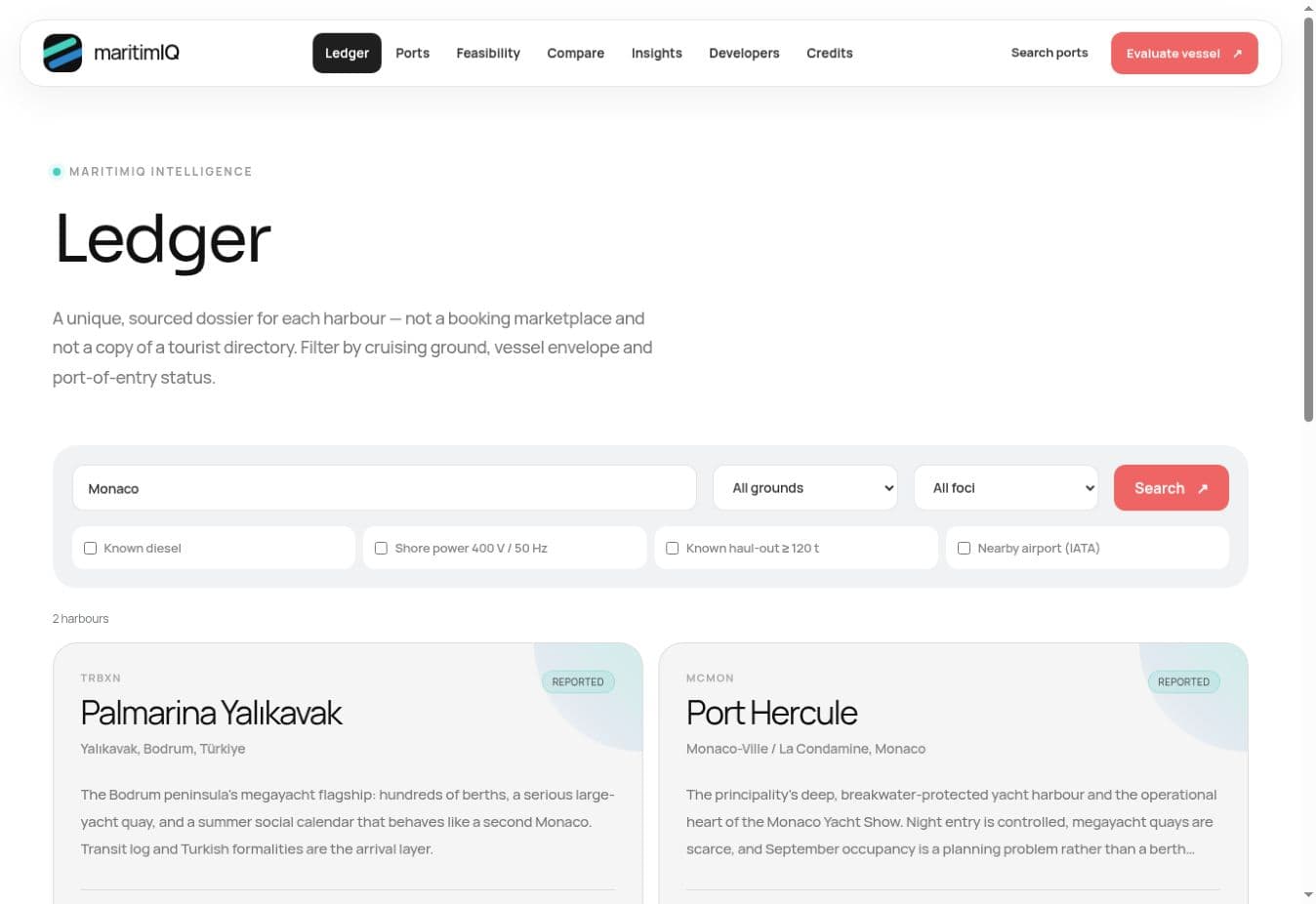
Searchable harbour ledger
A structured listing helps the right users discover the harbour without flattening it into a tourist directory.
ROLE-SPECIFIC FEATURES
Unify names, aliases, UN/LOCODE or local identifiers and current location under a stable UUID.
Model basins, piers, berth classes, physical berths, moorings, anchorages and approaches without fabricating detail.
Let visiting yachts compare their dimensions with published limits while making reservation and clearance dependencies explicit.
Expose approved fuel, utilities, waste, refit and tariff facts with dates, scope and licensing controls.
Supersede facts, publish notices and retain conflicts or history instead of silently overwriting the record.
USE CASES
Provide captains and agents with a structured summary that links back to official channels for confirmation.
Reduce obviously incompatible requests while keeping borderline or insufficiently evidenced cases for staff review.
Use one schema across a marina portfolio and syndicate approved facts to websites, apps and commercial partners.
COMMERCIAL API ACCESS
Marina and port systems can use MaritimIQ as a distribution and discovery layer. The API complements—rather than replaces—PMS, berth allocation, VTS and reservation systems.
/v1/harbors/:id/infrastructureDistribute the canonical physical hierarchy.
/v1/harbors/:id/servicesExpose governed marina and nearby service records.
/v1/harbors/:id/tariffsPublish dated tariff rules without presenting a booking quote.
/v1/harbors/:id/trafficUse traffic context only where observations support it.
Bearer keys, plan-aware limits and explicit scopes apply. API output is decision support—not a navigational chart, safety approval or live berth reservation.
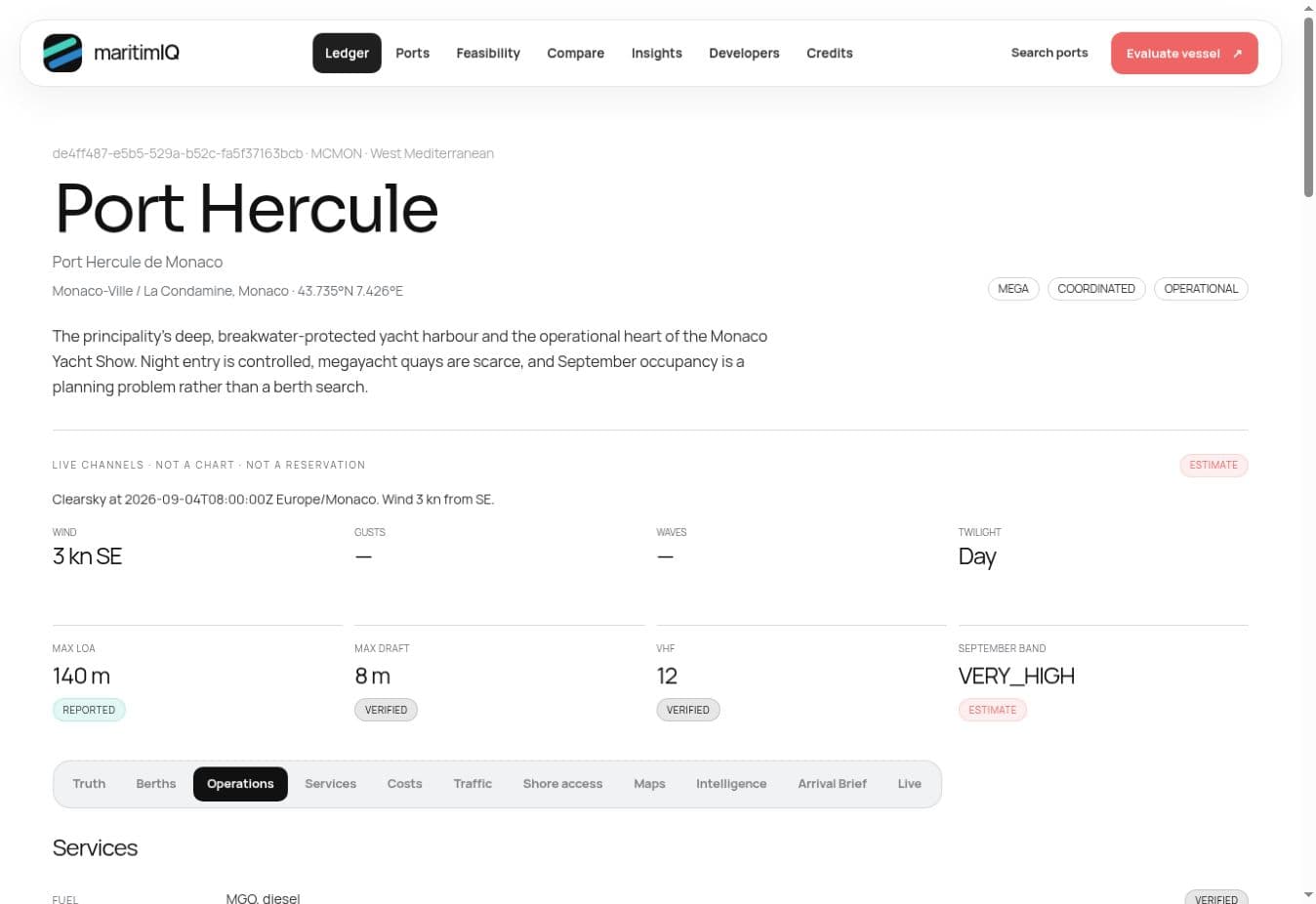
Port Hercule intelligence dossier
Operators can make published limits and services legible while keeping estimates and external confirmation visible.
A PRACTICAL WORKFLOW
Resolve identifiers, aliases and operator sources to one canonical harbour.
Expose only facts supported for public and licensed distribution.
Version changes and keep availability in the authoritative operational system.
TRUST MODEL
Decision-critical facts keep their source, observed date, confidence and conflict state.
Missing evidence is never quietly translated into no, zero, available or safe.
Accessible source material and permitted redistribution remain separate decisions.
QUESTIONS
No. It is an intelligence and distribution layer. Reservations, contracts, billing, access control and live berth allocation stay in the operator's PMS or operational systems.
No. AIS-derived traffic, observed occupancy, declared capacity and bookable availability are different data classes.
Corrections should enter with a source, evidence, effective date and distribution permission so the updated claim remains auditable.
RELATED SOLUTIONS