Every request arrives differently
Key vessel, formalities, service and timing information may be spread across email, messaging and unstructured forms.
HARBOUR DATA FOR YACHT AGENTS
Agents translate a captain's call into local action. MaritimIQ provides the structured harbour context behind that work—entry requirements, pilotage, services, contacts, tariffs, warnings, transfers and evidence gaps—without pretending to replace the agent's confirmation or local authority.
Receive better-structured requests from captains, managers and brokers.
Build repeatable arrival checklists around the yacht and port call.
Expose local service and guest logistics through client portals without losing provenance.
WHY THIS ROLE NEEDS IT
Build credible itineraries, coordinate shore-side work and answer client questions without confusing research with confirmation.
Key vessel, formalities, service and timing information may be spread across email, messaging and unstructured forms.
Port entry, customs eligibility, immigration, pilotage and health clearance each have different authorities and applicability.
Agent knowledge is valuable, but client-facing systems still need dates, source origin and a distinction between official facts and practical advice.
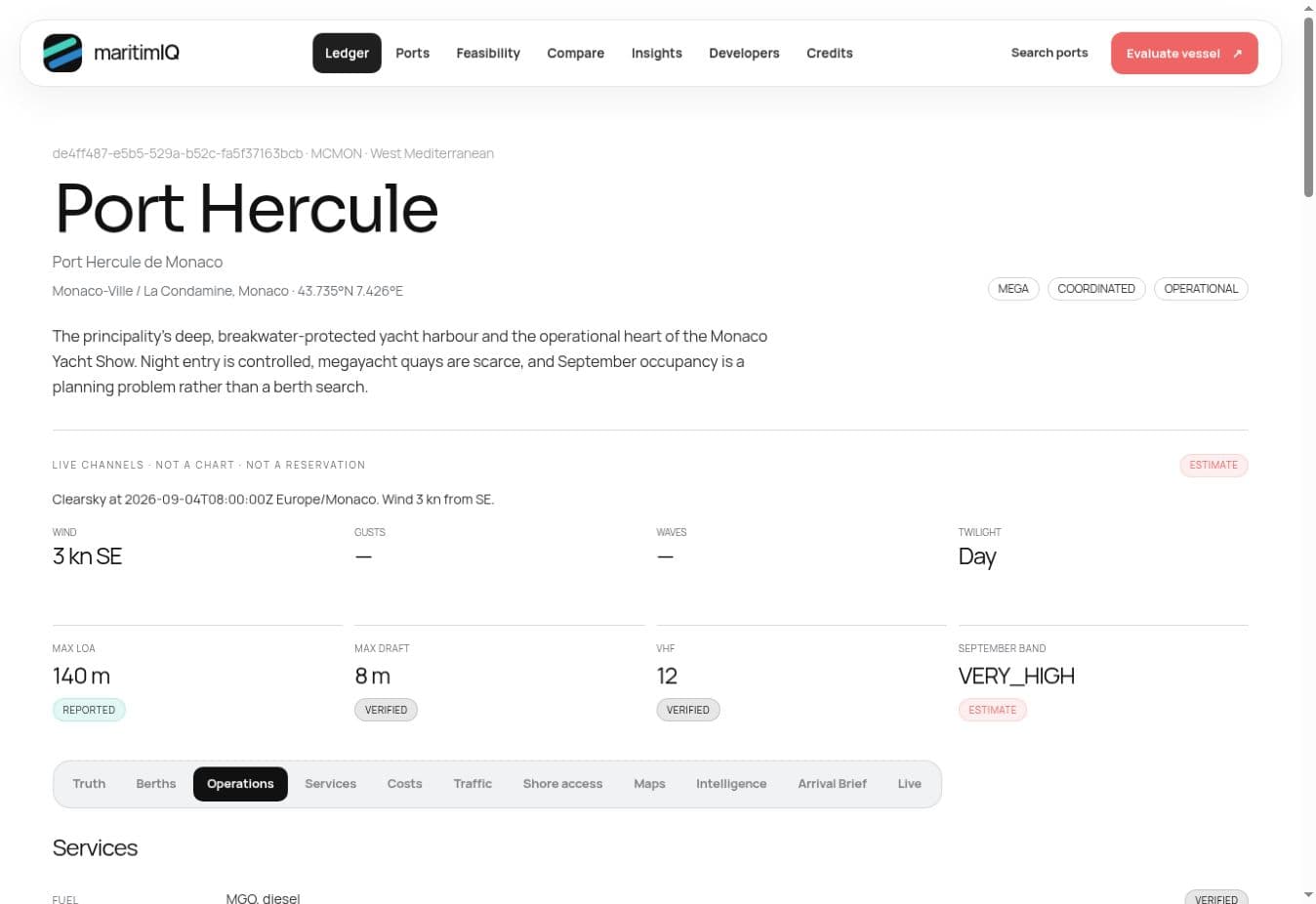
Port Hercule intelligence dossier
The operations view places rules, services and local context under one canonical harbour.
ROLE-SPECIFIC FEATURES
Structure entry, advance notice, pilotage, towage and clearance questions for the selected vessel and movement.
Keep harbour authority, marina office, customs, agent and service-provider roles distinct rather than storing one generic contact field.
Match requested fuel, utilities, waste, refit and provisioning to recorded facilities and clearly labelled third-party candidates.
See governed notices and event context that may increase pressure or change coordination requirements.
Connect airport, medical, transport and amenity context to the call without promising third-party performance.
USE CASES
Pre-fill the harbour context and ask the captain only for the vessel and call details needed to confirm local requirements.
Manage consistent information across several ports while retaining what is specific to each competent authority.
Use the API to display source-aware port information inside an agency or concierge workflow.
COMMERCIAL API ACCESS
Integrate port requirements and service context into agent CRMs, arrival forms and client portals. The API keeps authority rules, third-party candidates and unknowns structurally separate.
/v1/harbors/:id/entry-requirementsRetrieve port-entry rules and advance-notice fields.
/v1/harbors/:id/pilotageRead pilotage and applicability records without inventing exemptions.
/v1/harbors/:id/servicesPopulate service coordination with origin labels.
/v1/harbors/:id/warningsAdd current warning coverage to the arrival workflow.
Bearer keys, plan-aware limits and explicit scopes apply. API output is decision support—not a navigational chart, safety approval or live berth reservation.
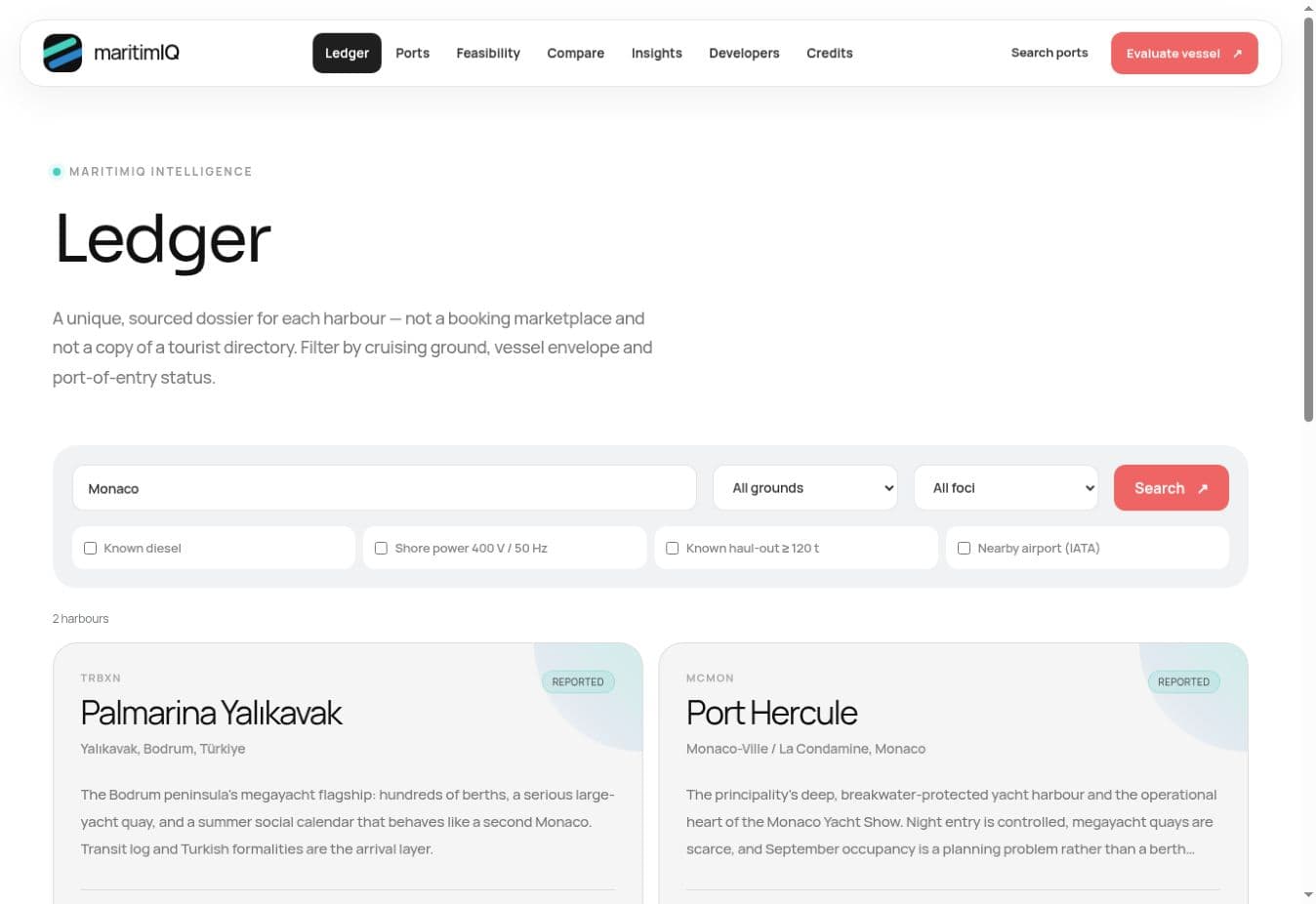
Searchable harbour ledger
Resolve the intended port before applying local procedures, contacts and service information.
A PRACTICAL WORKFLOW
Match the yacht and destination to stable records before starting coordination.
Use explicit unknowns as a targeted local confirmation list.
Give the client a clear answer with source and validity, not a detached assertion.
TRUST MODEL
Decision-critical facts keep their source, observed date, confidence and conflict state.
Missing evidence is never quietly translated into no, zero, available or safe.
Accessible source material and permitted redistribution remain separate decisions.
QUESTIONS
No. It structures the shared port picture and remaining questions. Local confirmation, representation and service delivery remain the agent's role.
The data model supports source and evidence records rather than silent edits. Operational submissions should be reviewed, dated and assigned the correct authority level.
No. THIRD_PARTY_NEARBY is kept distinct from official or operator-published facilities throughout the interface and API.