Fragmented pre-arrival research
Approach notes, port limits, formalities, services, tariffs and contacts often live in different publications with different dates and authority levels.
PORT INTELLIGENCE FOR YACHT CAPTAINS
MaritimIQ turns scattered harbour research into a vessel-specific pre-arrival picture. Captains can qualify a destination, expose unresolved constraints and prepare a source-backed brief before confirming details with the harbour, agent and official publications.
Screen candidate harbours against the yacht's LOA, beam, draft and air draft.
See conflicts, stale evidence and missing facts before they become late operational surprises.
Give the bridge, management and shore team one explainable arrival brief.
WHY THIS ROLE NEEDS IT
Prepare arrivals, manage the yacht and translate technical port facts into decisions for crew, guests and owners.
Approach notes, port limits, formalities, services, tariffs and contacts often live in different publications with different dates and authority levels.
Suitability changes with vessel dimensions, date, commercial status and the specific infrastructure supported by evidence.
Weather and traffic observations help planning, but they are not clearance, an official chart or proof that a berth is available.
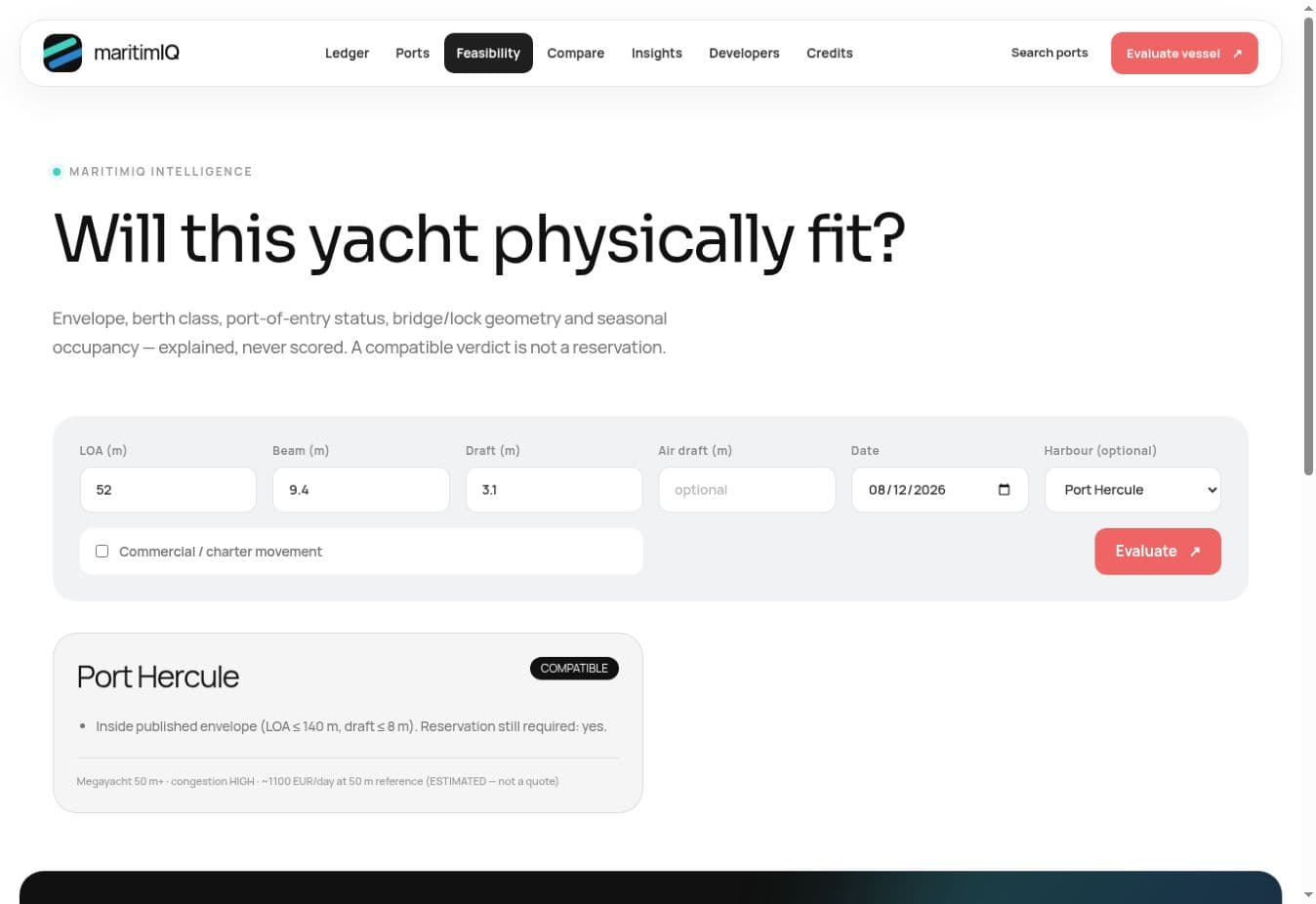
Vessel-to-harbour feasibility
A vessel-specific result explains the published envelope and keeps the berth reservation requirement visible.
ROLE-SPECIFIC FEATURES
Test the yacht against published envelopes and see COMPATIBLE, RESTRICTED, INCOMPATIBLE or INSUFFICIENT_DATA with the facts behind the result.
Review datum-aware depths, approach channels, entrance constraints, bridge or lock geometry and evidence quality without turning contextual data into navigation advice.
Keep port entry, pilotage, towage, customs, immigration and health requirements separate, including applicability and advance-notice uncertainty.
Inspect active notices, coverage state, dates and source lineage. No matching warning is never presented as an all-clear.
Bring fit, costs, services, restrictions and unresolved questions into one concise decision-support brief that avoids clearance language.
USE CASES
Enter the yacht's dimensions and arrival date, review constraints and send the remaining confirmation questions to the harbour or local agent.
Compare nearby harbours on the same vessel assumptions and identify which alternative has fewer unresolved operational dependencies.
Give relief officers a stable harbour identity, evidence trail and current list of unknowns instead of an untraceable collection of bookmarks.
COMMERCIAL API ACCESS
Connect the same truth model to bridge, fleet or voyage-planning software. API responses preserve reason graphs, confidence and UNKNOWN states so downstream tools do not silently turn missing data into approval.
/v1/compatibilityEvaluate a yacht against one harbour's supported physical facts.
/v1/harbors/:id/arrival-briefRetrieve the composed, source-bounded arrival brief.
/v1/harbors/:id/warningsDisplay warning coverage and current governed notices.
/v1/missionCombine evidence-bounded constraints with a proposed arrival time and vessel profile.
Bearer keys, plan-aware limits and explicit scopes apply. API output is decision support—not a navigational chart, safety approval or live berth reservation.
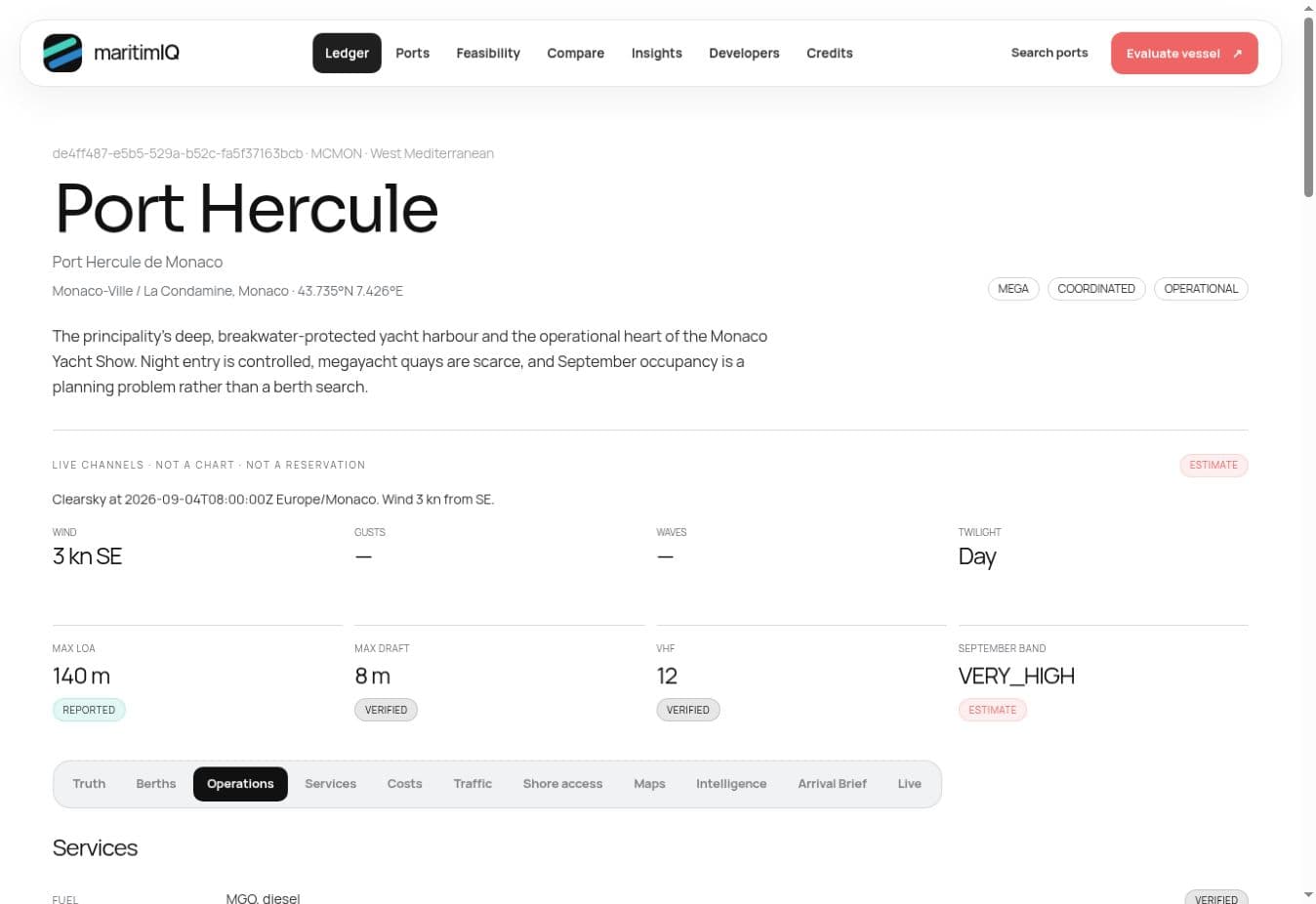
Port Hercule intelligence dossier
The dossier keeps dimensions, live context, source status and operational tabs in one place.
A PRACTICAL WORKFLOW
Resolve the harbour to its canonical identity rather than relying on a name or free-text location.
Apply the yacht, date and operating context to the available evidence.
Take the remaining questions to official publications, the harbour and the appointed agent.
TRUST MODEL
Decision-critical facts keep their source, observed date, confidence and conflict state.
Missing evidence is never quietly translated into no, zero, available or safe.
Accessible source material and permitted redistribution remain separate decisions.
QUESTIONS
No. It is decision support for research and coordination. Official charts, notices, harbour directions and master/pilot judgement remain controlling.
No. Physical compatibility, declared capacity, reservation and live availability are separate facts. MaritimIQ never derives availability from AIS traffic.
The conflict stays visible with its evidence and date. The platform does not silently choose the more convenient number.
RELATED SOLUTIONS