Place and facility are not the same
A municipality or UN/LOCODE location may contain several distinct harbours, terminals or marinas that need separate canonical identities.
PORT DATA FOR POLICY AND RESEARCH
MaritimIQ gives public and research teams a consistent way to identify yacht harbours and examine the evidence available for infrastructure, services, access and operational context. Publication eligibility and source permissions are separate from research storage, supporting more responsible public outputs.
Reconcile international and local identifiers across a worldwide harbour corpus.
Measure where public evidence is deep, partial, conflicting or missing.
Connect maritime infrastructure with transport, tourism and service-access research through the API.
WHY THIS ROLE NEEDS IT
Use structured harbour intelligence in underwriting, due diligence, public planning and software products.
A municipality or UN/LOCODE location may contain several distinct harbours, terminals or marinas that need separate canonical identities.
A source can support internal research without permitting commercial redistribution or public display of every field.
Frequently documented regions may appear more capable unless analysis distinguishes observed facts from missing evidence.
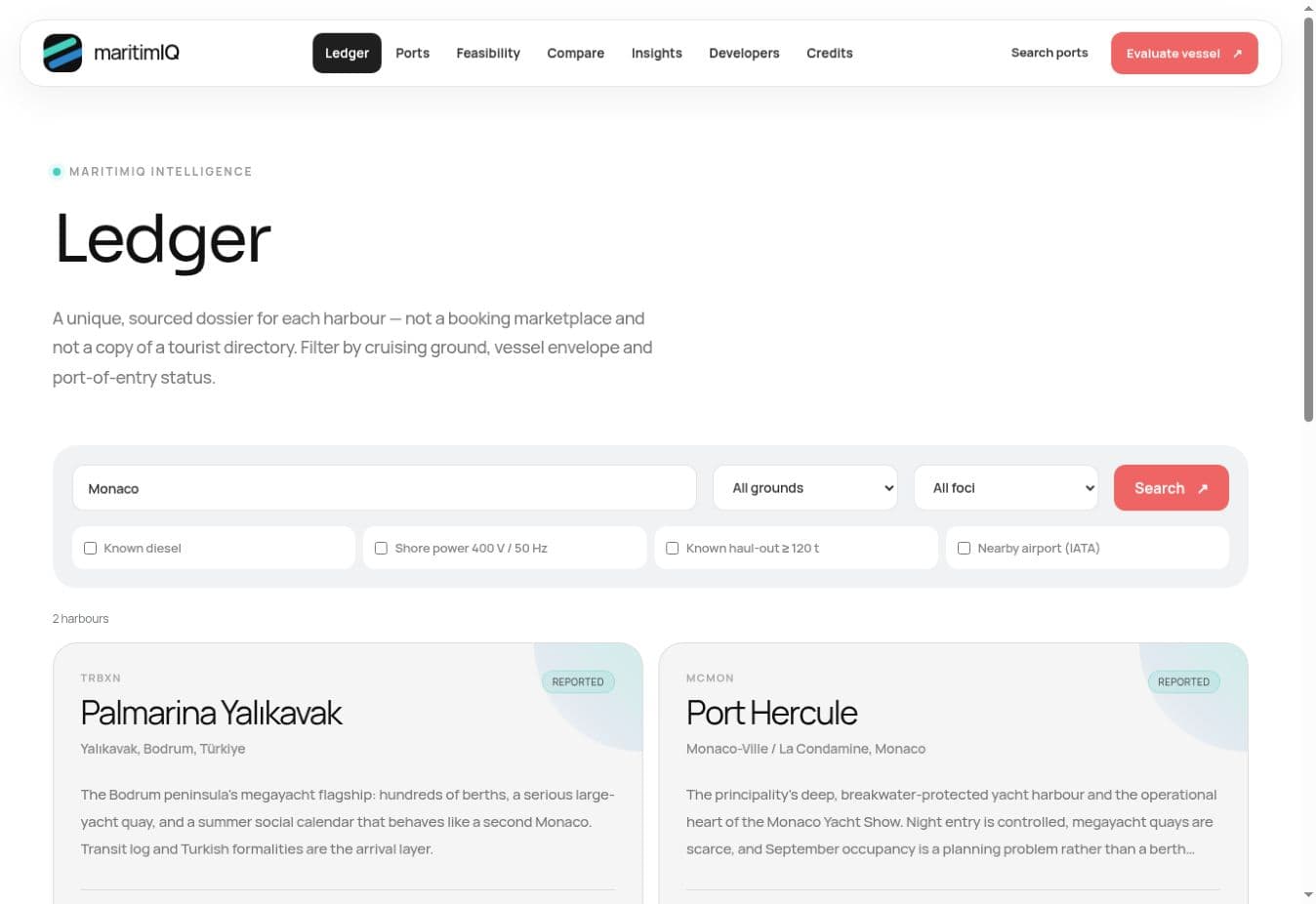
Searchable harbour ledger
The public surface exposes eligible identities while research and publication decisions remain separate.
ROLE-SPECIFIC FEATURES
Work with 18,528 public harbour identities across 237 countries in the current certified production snapshot.
Keep canonical research entities separate from the subset eligible for public search and API surfaces.
Trace facts to source, permission state, confidence, observation date and temporal validity.
Inspect which domains and geographies have sufficient evidence and where public-data programmes could help.
Study airport, transport, medical and service relationships without copying them into the harbour identity itself.
USE CASES
Compare local inventories with UN/LOCODE, WPI and the canonical graph while quarantining suspicious geography.
Map yacht-harbour access and evidence gaps alongside airports, transport and destination infrastructure.
Use scoped API extracts for reproducible studies while documenting coverage and licensing limits.
COMMERCIAL API ACCESS
Public agencies and research teams can query the canonical graph, coverage and change records through the commercial API. Licensing-aware serializers help prevent an accessible source from being mistaken for a redistributable field.
/v1/harborsQuery public-eligible canonical harbour identities and geography.
/v1/coverageAnalyse evidence depth and domain coverage.
/v1/changesTrack material changes and temporal records.
/v1/harbors/:id/observationsRetrieve governed observation context with units and dates.
Bearer keys, plan-aware limits and explicit scopes apply. API output is decision support—not a navigational chart, safety approval or live berth reservation.
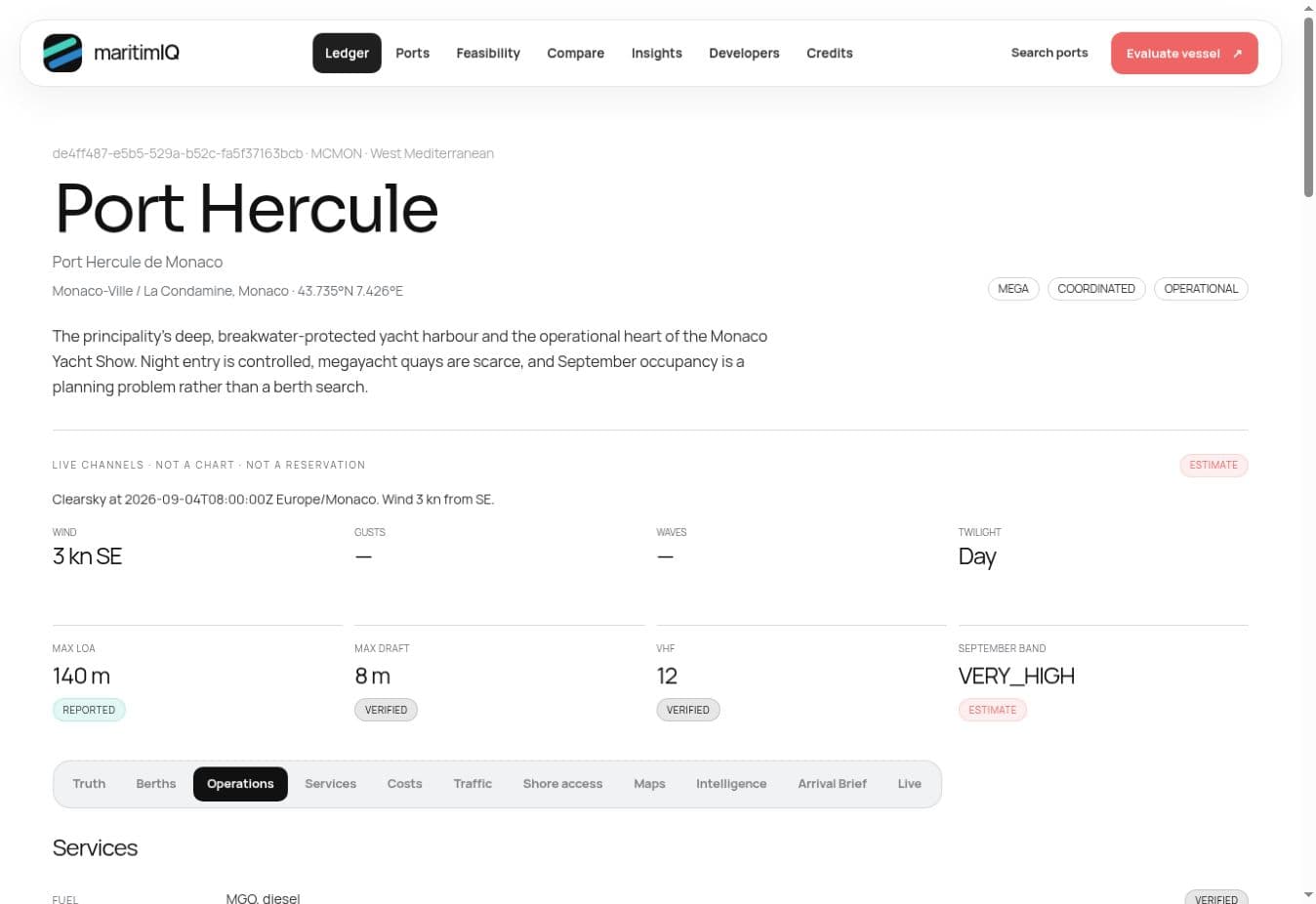
Port Hercule intelligence dossier
A deep dossier shows how identity, infrastructure, operations and live context relate without becoming an official register.
A PRACTICAL WORKFLOW
Match source records to canonical harbours and retain unresolved candidates or geography issues.
Measure evidence, permission and temporal validity before analysis or publication.
Report coverage and uncertainty alongside findings and link controlling official sources.
TRUST MODEL
Decision-critical facts keep their source, observed date, confidence and conflict state.
Missing evidence is never quietly translated into no, zero, available or safe.
Accessible source material and permitted redistribution remain separate decisions.
QUESTIONS
No. It is a governed commercial intelligence graph that links to and reconciles official and contextual sources. Competent authorities remain authoritative.
No. Source accessibility and redistribution permission are separate. API fields are filtered according to licensing and plan entitlements.
Suspicious coordinates or identity matches are quarantined for review rather than silently corrected into the public corpus.
RELATED SOLUTIONS