Port identity is harder than a name
Aliases, local spellings, UN/LOCODE, WPI and place-level concepts can refer to one harbour—or to several distinct facilities.
MARITIME PORT DATA API
MaritimIQ provides a commercial `/v1` API for products that need more than a port name and coordinates. Stable identities, aliases, infrastructure, vessel-fit reasoning, services, warnings, evidence and licensing semantics arrive through one versioned contract.
Resolve fragmented names and external identifiers to canonical harbour UUIDs.
Add port intelligence without turning nulls into false negatives or estimates into official truth.
Consume change events and govern distribution with scopes, plans and licensing-aware responses.
WHY THIS ROLE NEEDS IT
Use structured harbour intelligence in underwriting, due diligence, public planning and software products.
Aliases, local spellings, UN/LOCODE, WPI and place-level concepts can refer to one harbour—or to several distinct facilities.
A boolean cannot represent unknown, conflicting, stale, not covered and known-no without losing operational meaning.
A response must consider whether the underlying source permits redistribution, not merely whether the application can read the value.
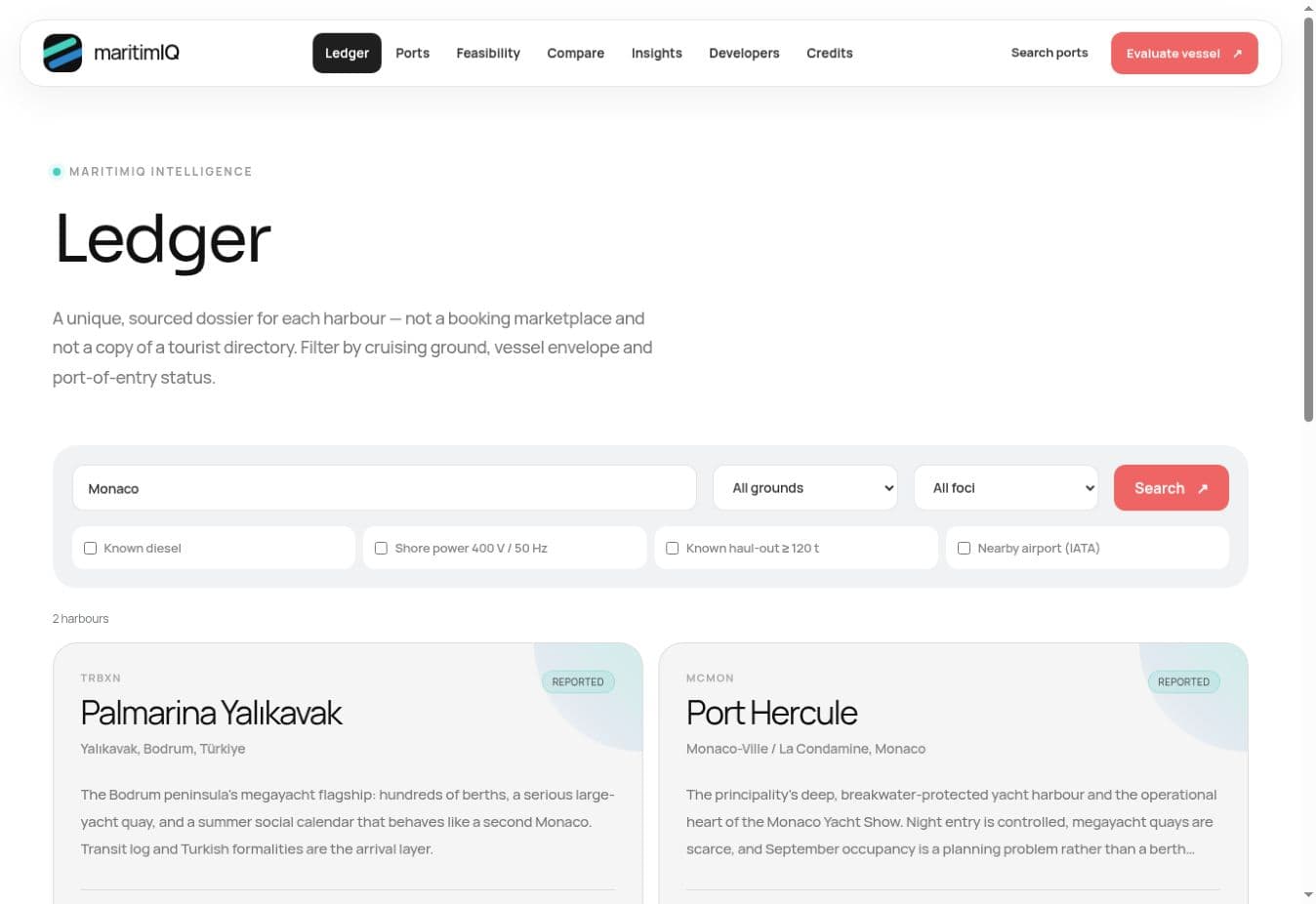
Searchable harbour ledger
The human interface and API resolve to the same canonical harbour concepts and truth states.
ROLE-SPECIFIC FEATURES
Use UUIDs, identifiers, aliases and current/historical locations to reconcile downstream records.
Build against documented `/v1` routes and a machine-readable contract.
Use live and sandbox bearer keys, scopes, plan entitlements, rate limits and durable usage metering.
Receive confidence, provenance, UNKNOWN, conflicts and coverage states rather than flattened marketing claims.
Query governed change events and domain freshness states for downstream monitoring workflows.
USE CASES
Add vessel-aware harbour dossiers and arrival briefs inside an existing operations product.
Enrich discovery with canonical infrastructure and suitability while keeping real availability in the booking source.
Connect yacht ports to airports, services and destination context without mislabelling estimated relationships.
COMMERCIAL API ACCESS
Start with the OpenAPI document and sandbox keys, then request only the scopes your product needs. Health and readiness are public; commercial harbour routes require authenticated access.
/v1/harborsSearch the public-eligible canonical worldwide corpus.
/v1/openapiGenerate clients and validate the versioned contract.
/v1/compatibilityAdd explainable vessel-to-harbour evaluation.
/v1/changesIntegrate governed, filterable change events.
Bearer keys, plan-aware limits and explicit scopes apply. API output is decision support—not a navigational chart, safety approval or live berth reservation.
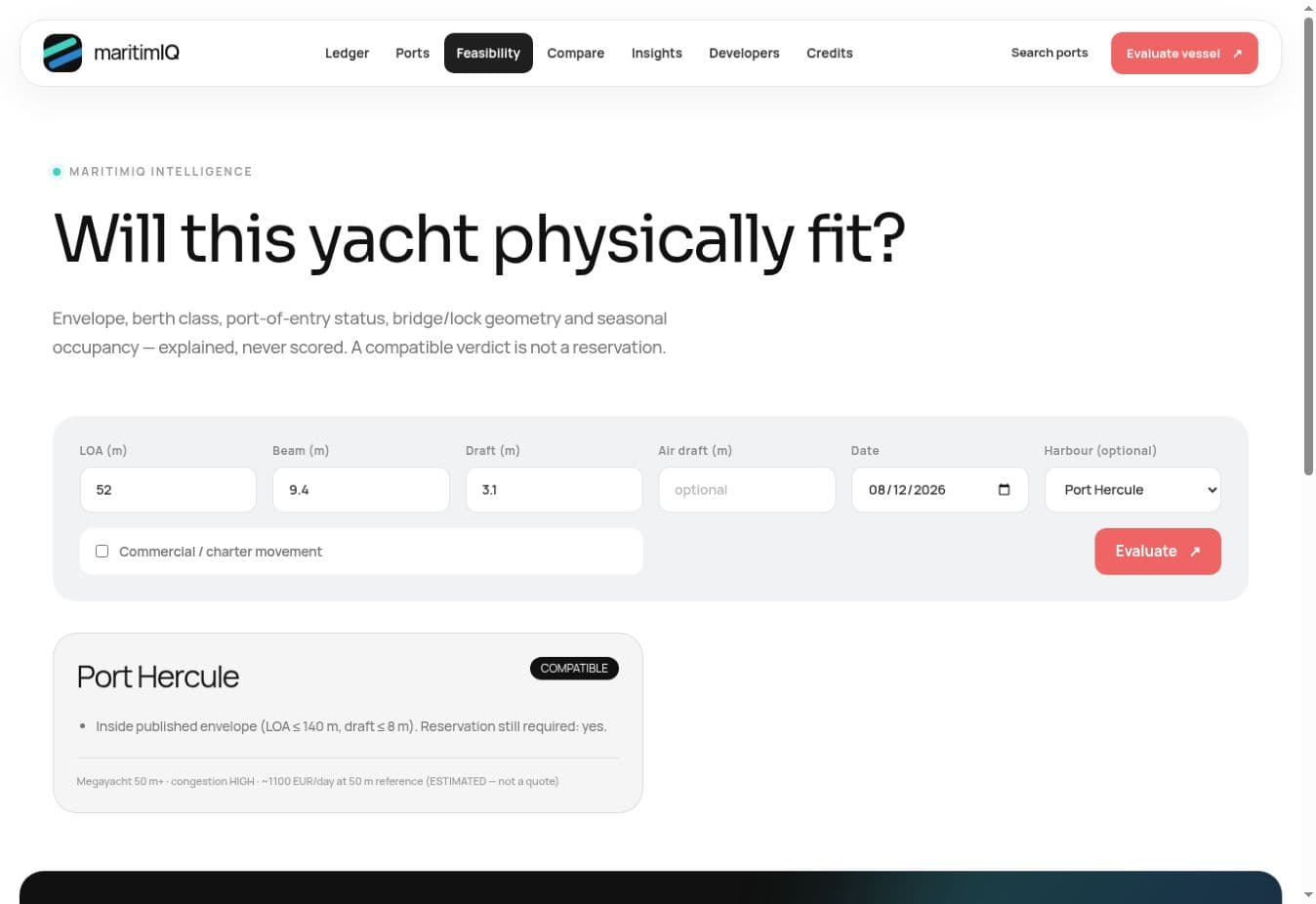
Vessel-to-harbour feasibility
Downstream software can render the reasoned result without inventing a berth or safety approval.
A PRACTICAL WORKFLOW
Use sandbox credentials and OpenAPI to map the contract into your product.
Select scopes, entitlements and redistribution rules for the use case.
Meter usage, handle explicit errors and consume change events without losing semantics.
TRUST MODEL
Decision-critical facts keep their source, observed date, confidence and conflict state.
Missing evidence is never quietly translated into no, zero, available or safe.
Accessible source material and permitted redistribution remain separate decisions.
QUESTIONS
Yes. Sandbox `miq_test_` keys are distinct from production `miq_live_` keys and support controlled integration testing.
Endpoints use explicit UNKNOWN, NOT_COVERED or INSUFFICIENT_DATA states where applicable rather than treating an absent value as zero or no.
It can enrich those products with harbour intelligence, but it is not an official chart service and does not create availability. Navigation and booking sources remain separate.
RELATED SOLUTIONS