Risk data must be defensible
A score without visible sources, dates and reasons is difficult to challenge, audit or apply proportionately.
MARINE INSURANCE PORT INTELLIGENCE
MaritimIQ gives marine risk professionals a defensible view of the harbour facts relevant to a yacht call. Each material statement can retain source, confidence, date and conflict status, allowing an underwriter or surveyor to see both the evidence and its limitations.
Screen vessel-to-harbour assumptions during underwriting or voyage review.
Preserve what was known, conflicting or unknown at a relevant point in time.
Bring structured warnings, infrastructure and traffic context into internal risk tools.
WHY THIS ROLE NEEDS IT
Use structured harbour intelligence in underwriting, due diligence, public planning and software products.
A score without visible sources, dates and reasons is difficult to challenge, audit or apply proportionately.
Physical fit, approach constraints, pilotage, services, warnings and traffic are related but not interchangeable risk signals.
MaritimIQ does not claim a complete raw AIS history or reconstruct causation from partial traffic observations.
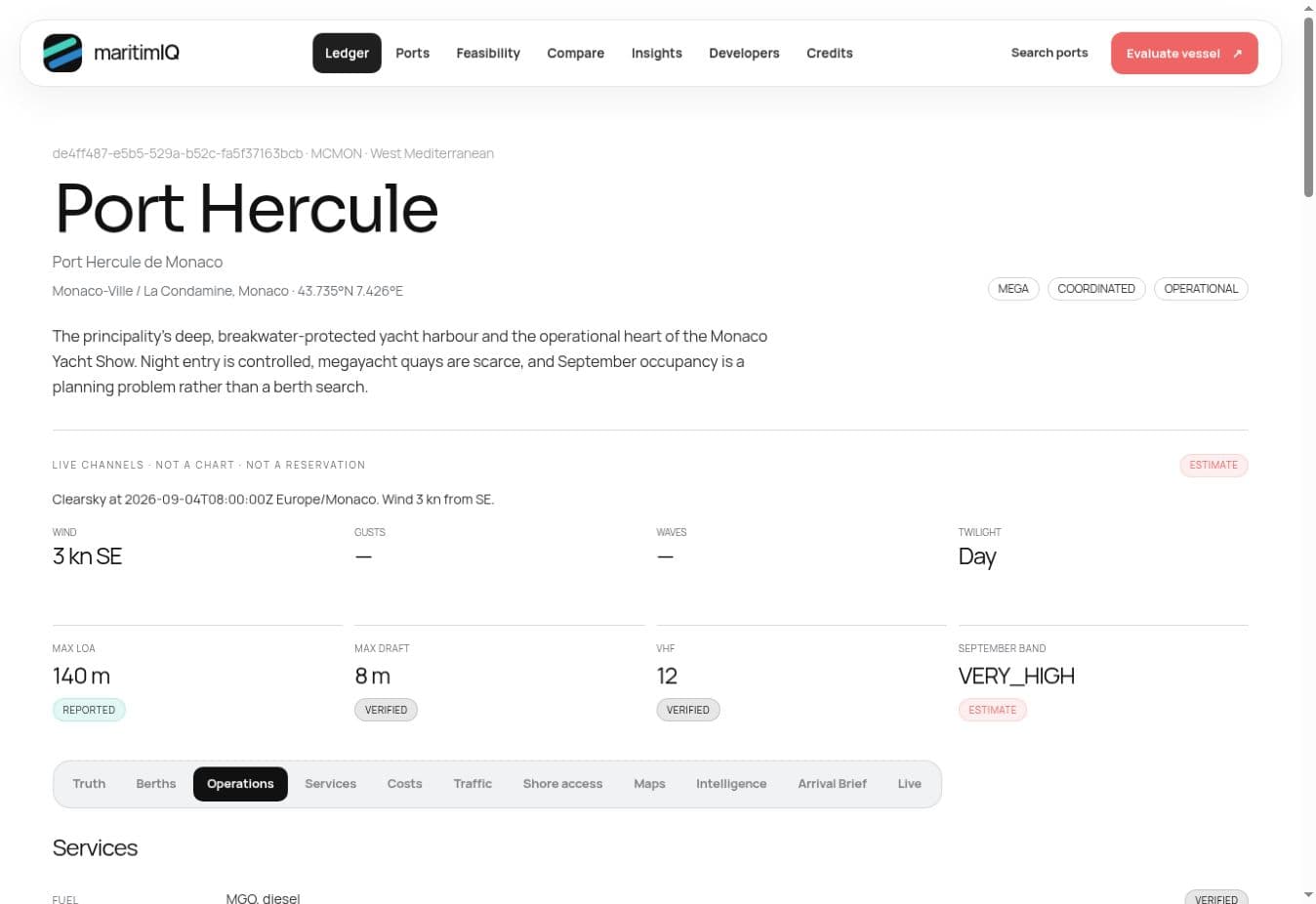
Port Hercule intelligence dossier
Material harbour facts retain confidence labels and remain separate from modelled context.
ROLE-SPECIFIC FEATURES
Trace facts to authoritative, verified, reported, estimated, conflicting or unverified evidence states.
Evaluate the recorded physical relationship between a yacht and harbour with reason codes and missing inputs.
See governed warning records and whether the relevant source/time/area was covered.
Retain superseded identifiers, locations and material change events instead of erasing the prior state.
Summarise evidence completeness and dependencies without presenting the result as a loss probability or safety rating.
USE CASES
Identify port calls where vessel fit, pilotage or evidence gaps justify a specific survey or underwriting question.
Retrieve the recorded harbour facts and warnings around a period while keeping them separate from conclusions about cause or liability.
Use canonical IDs and structured port attributes to compare exposure consistently across insured yachts.
COMMERCIAL API ACCESS
Integrate harbour evidence into underwriting, claims and survey platforms using scoped keys and licensing-aware fields. Reason graphs and UNKNOWN values remain machine-readable for internal policy rules.
/v1/harbors/:id/readinessInspect evidence completeness and unresolved dependencies.
/v1/harbors/:id/warningsRetrieve warning records and coverage semantics.
/v1/compatibilityTest a recorded vessel-to-harbour relationship.
/v1/harbors/:id/changesReview temporal changes for one harbour.
Bearer keys, plan-aware limits and explicit scopes apply. API output is decision support—not a navigational chart, safety approval or live berth reservation.
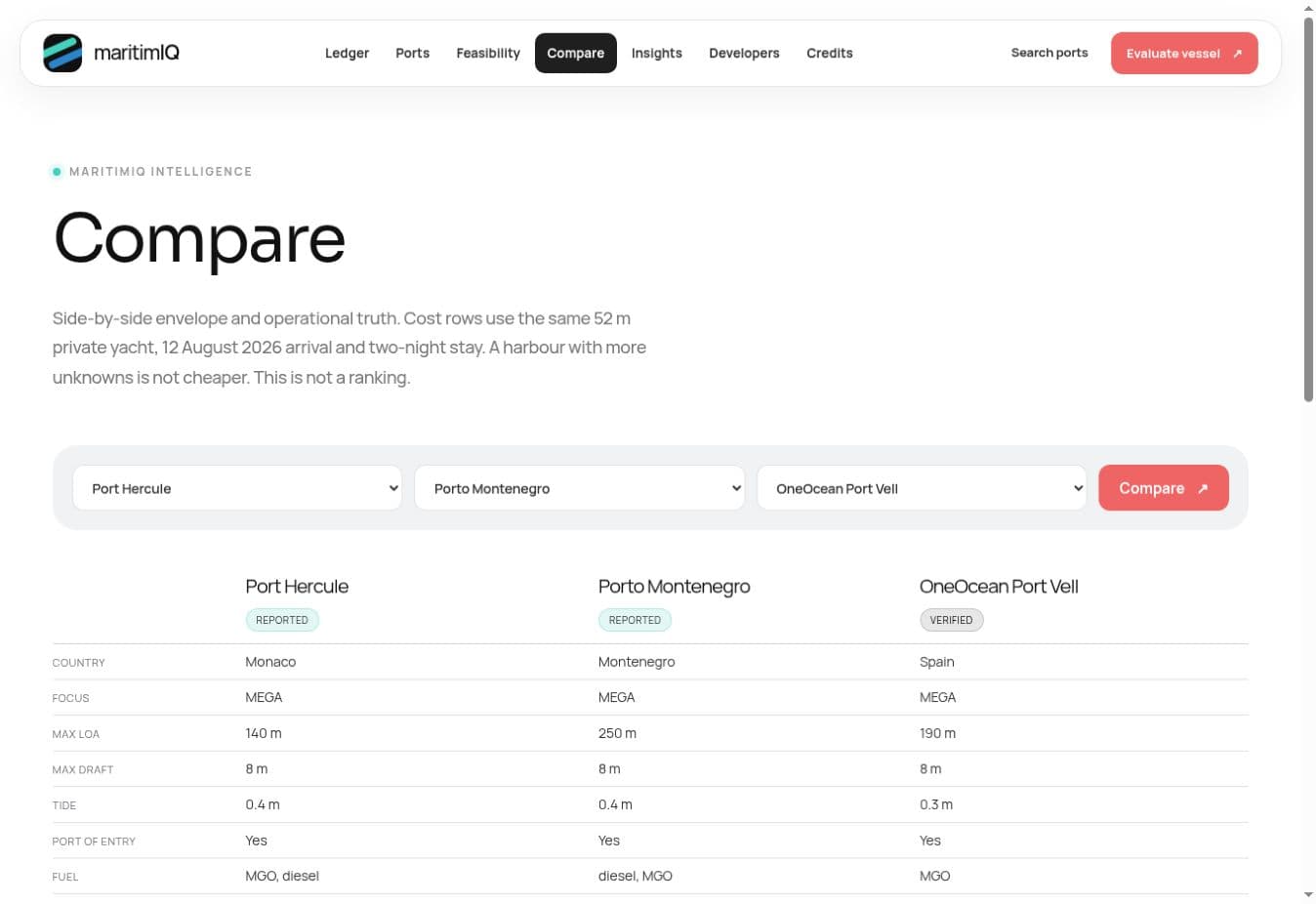
Side-by-side harbour comparison
Comparable rows expose both values and missing coverage instead of collapsing them into one risk score.
A PRACTICAL WORKFLOW
Identify the vessel, harbour and time context relevant to the risk question.
Review source, confidence, conflicts, coverage and missing facts.
Direct underwriting, survey or claims expertise to the assumptions that matter.
TRUST MODEL
Decision-critical facts keep their source, observed date, confidence and conflict state.
Missing evidence is never quietly translated into no, zero, available or safe.
Accessible source material and permitted redistribution remain separate decisions.
QUESTIONS
No. Readiness and reliability outputs explain evidence and operational dependencies; they are not loss probabilities, safety scores or underwriting decisions.
No. It can supply sourced harbour context. Causation, liability and policy response require the complete evidential record and professional assessment.
The current product supports bounded traffic and port-call intelligence where evidence exists, but it does not claim a complete raw historical AIS warehouse.
RELATED SOLUTIONS